
API Integration Services
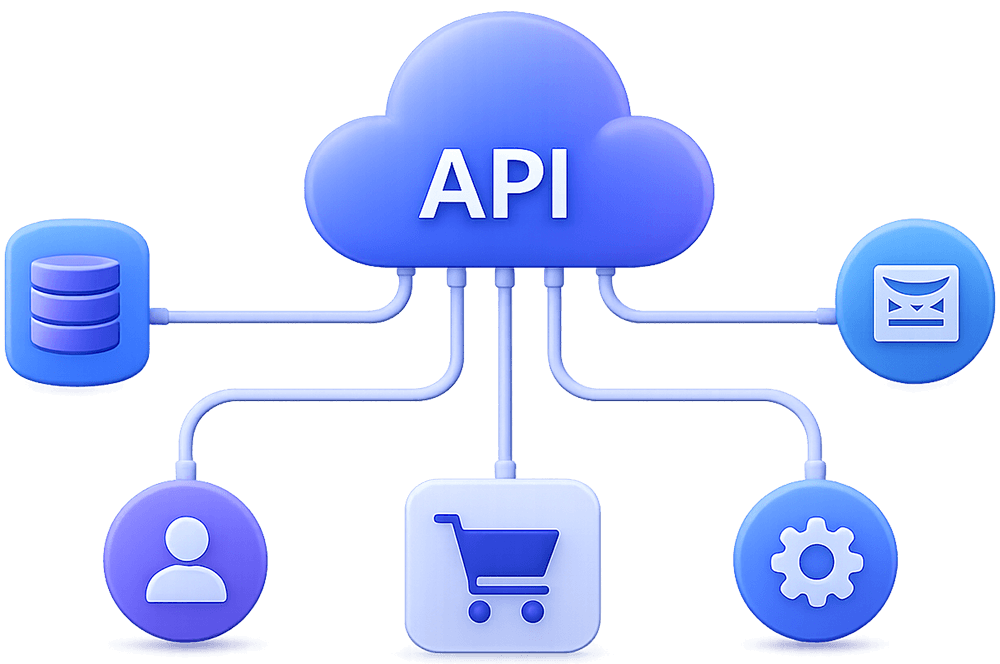
Modern businesses rely on multiple platforms for websites, eCommerce, customer management, payments, analytics, communications, marketing, operations, and reporting.
The real challenge is getting those systems to work together reliably.
I provide custom API integration services for businesses and agencies that need WordPress, web applications, SaaS platforms, internal systems, and third-party services to exchange data and automate workflows.
I’m Tara Swain, a senior WordPress engineer and software architect with more than 20 years of web development experience. A significant part of my work involves connecting platforms through REST APIs, OAuth, webhooks, scheduled synchronization, background processing, and custom middleware.
Connecting the Systems Your Business Already Uses
Businesses rarely operate inside a single application.
Customer data may live in a CRM, orders in an eCommerce platform, payments in a payment gateway, analytics in another system, reviews in another platform, and operational data somewhere else entirely.
API integrations connect those systems so information can move automatically instead of being copied manually between applications.
Common integration goals include:
- Synchronizing customer information between platforms
- Importing orders from an eCommerce system
- Sending leads into a CRM
- Automating SMS and email communication
- Synchronizing inventory or product data
- Importing analytics and advertising data
- Receiving real-time webhook notifications
- Generating reports from multiple data sources
- Connecting internal systems with public-facing applications
- Automating repetitive operational workflows
Custom REST API Integrations
REST APIs are one of the most common ways modern applications exchange data.
I build integrations that securely consume, process, transform, store, and
send data between external APIs and WordPress or custom business applications.
This may include:
- GET, POST, PUT, PATCH, and DELETE operations
- Authentication and authorization
- Request validation
- Data transformation
- Pagination
- Filtering
- Error handling
- Retry logic
- Rate-limit handling
The goal is to build an integration that continues working reliably after the
initial proof of concept.
OAuth & API Authentication
Many APIs require more than a static API key.
I work with authentication methods such as:
- OAuth 2.0
- Bearer tokens
- API keys
- Client credentials
- Basic authentication
- Signed requests
OAuth integrations often require handling access tokens, refresh tokens, expiration, scopes, authorization callbacks, and account reconnection.
These details are important because authentication failures are one of the most common causes of broken integrations.
Webhook Integrations
Webhooks allow external systems to notify your application when something
happens instead of requiring your application to repeatedly poll for changes.
Webhook-driven workflows may include:
- New order notifications
- Payment updates
- Review notifications
- Customer updates
- Message status changes
- Subscription events
- Inventory changes
- CRM updates
Production webhook implementations should also account for duplicate events,
retries, authentication, validation, logging, and delayed processing.
Real-Time & Scheduled Data Synchronization
Not every integration needs to operate in real time.
Depending on the platform and business requirement, synchronization may be:
- Real-time through webhooks
- Near real-time
- Scheduled every few minutes
- Hourly
- Daily
- Triggered manually
I design synchronization strategies based on API limits, business urgency,data volume, server resources, and failure recovery requirements.
Bidirectional API Synchronization
Some projects require information to move in both directions.
For example:
- A customer changes information in a portal
- The CRM receives the update
- A change made in the CRM is sent back to the portal
Bidirectional synchronization introduces additional complexity because the integration must prevent loops, resolve conflicting updates, and determine which system is authoritative for each field.
I design these workflows around clear ownership rules so the systems remain predictable.
WordPress API Integrations
WordPress can act as both an API consumer and an API provider.
I build integrations where WordPress:
- Retrieves data from external APIs
- Sends data to third-party systems
- Receives webhooks
- Provides custom REST API endpoints
- Acts as an administration layer for external data
- Coordinates workflows between multiple platforms
For complex applications, this functionality is usually implemented through a custom WordPress plugin rather than placed inside a theme.
eCommerce API Integrations
AI can help turn operational data into explanations and recommendations that are easier for business users to understand.
Examples include:
- Sales summaries
- Performance explanations
- Trend identification
- Location comparisons
- Marketing insights
- Review analysis
- Executive summaries
Instead of asking users to interpret multiple charts and tables manually, AI can provide a contextual explanation based on the underlying data.
CRM Integrations
Business dashboards traditionally show what happened.
AI can add another layer by helping explain why a metric changed and what a user may want to investigate next.
This may include:
- Automated KPI summaries
- Trend explanations
- Performance comparisons
- Anomaly descriptions
- Location-specific insights
- Natural-language questions about business data
Twilio & Communication Integrations
I have extensive experience integrating communication workflows through Twilio.
This can include:
- SMS
- MMS
- Voice calling
- Call routing
- Voicemail
- Call notifications
- Automated messaging
- Delivery status callbacks
- Webhooks
Communication systems often require careful handling of asynchronous events, retries, status updates, and failure scenarios.
Google API Integrations
I also work extensively with Google APIs for analytics, advertising, business
data, and reporting.
Examples include:
- Google Analytics
- Google Ads
- Google Business-related data
- Google Maps and Places
- Geocoding
These integrations can feed dashboards, reports, automation workflows, and multi-location business platforms.
AI API Integrations
AI services can be integrated into existing business applications without
requiring the entire platform to be rebuilt around AI.
Examples include:
- Automated review responses
- Business insights
- Content assistance
- Customer communication
- Data summarization
- Document processing
- Workflow decisions
I focus on integrating AI where it improves an existing workflow rather than
adding it simply because it is available.
Data Transformation & Mapping
Two systems rarely represent information in exactly the same way.
One platform may use different field names, identifiers, status values, date formats, or data structures from another.
Integration work often requires a transformation layer that maps the source system into the format expected by the destination.
This may involve:
- Field mapping
- Status mapping
- Date and timezone conversion
- Identifier matching
- Address normalization
- Nested JSON processing
- Data validation
Error Handling & Reliability
The difference between a demo integration and a production integration is
often how failures are handled.
External APIs can become unavailable, return invalid responses, enforce rate
limits, expire credentials, or change data unexpectedly.
I design integrations with appropriate:
- Error logging
- Retries
- Failure alerts
- Request tracking
- Duplicate protection
- Fallback logic
A business should be able to understand when an integration fails and recover without silently losing important data.
Background Processing
Large integrations should not make users wait while thousands of records are
processed inside a normal page request.
Depending on the project, I use scheduled jobs, queues, background processing,
or server cron tasks for operations such as:
- Large data imports
- Order synchronization
- Analytics processing
- Report generation
- Bulk API operations
- Notification processing
API Rate Limits & Caching
Most third-party APIs impose limits on how frequently applications can make
requests.
Good integration architecture reduces unnecessary API traffic through
strategies such as:
- Local caching
- Incremental synchronization
- Batch processing
- Webhook-driven updates
- Retry delays
This improves reliability while reducing latency and external API usage.
API Security
API integrations often handle credentials and business-critical data, so
security must be part of the architecture.
This includes:
- Secure storage of credentials
- HTTPS communication
- OAuth scopes
- Token expiration and refresh
- Webhook authentication
- Signature verification
- Permission controls
- Input validation
Legacy API Integrations
I also work with existing integrations that were built years ago and have become unreliable or difficult to maintain.
Common problems include:
- Deprecated API versions
- Expired authentication methods
- Hardcoded credentials
- No retry handling
- Missing logs
- Broken webhooks
- Poor error handling
- Slow synchronization
I can audit the integration and determine whether it should be repaired, refactored, or rebuilt.
Custom Integration Middleware
Sometimes connecting two platforms directly is not the best architecture.
When several systems need to exchange information, I may build a lightweight middleware or integration layer that manages authentication, transformation, logging, routing, and synchronization independently from the individual applications.
This can make complex integrations easier to maintain and prevent business logic from becoming tightly coupled to a single platform.
Platforms & Technologies I Work With
- WordPress
- WooCommerce
- Shopify
- Twilio
- Stripe
- Google APIs
- OpenAI APIs
- CRM platforms
- POS systems
- Review management platforms
- Email APIs
- Analytics platforms
- Custom REST APIs
- PHP
- JavaScript
- Vue.js
- MySQL / MariaDB
- OAuth
My API Integration Process
1. Understand the Business Workflow
2. Review the API
I evaluate authentication, endpoints, data structures, rate limits,
webhook capabilities, and platform restrictions.
3. Design the Integration
4. Develop & Test
5. Deploy & Monitor
6. Maintain
Who I Work With
API integration services are a good fit for:
- Businesses connecting existing software platforms
- US agencies needing specialist integration development
- WordPress websites that need external business data
- WooCommerce stores connecting fulfillment or operational systems
- Multi-location organizations aggregating data from multiple platforms
- Businesses replacing manual data entry with automation
- Teams maintaining unreliable legacy integrations
- Companies building portals, dashboards, and reporting platforms
Need to Connect Your Business Systems?
If your team is manually moving information between platforms, working around disconnected systems, or maintaining an API integration that has become unreliable, I can help design and build a cleaner solution.
Whether you need a focused third-party integration or a larger workflow connecting several business systems, the goal is to make data move reliably, securely, and with as little manual intervention as possible.
Explore my case studies to see examples of integrations, automation systems, analytics platforms, communication workflows, and business applications, or contact me to discuss your API integration project.